
In modern portable and compact audio systems, Class-D designs routinely deliver >90% efficiency and power densities that let 60–65 W stereo solutions fit on small PCBs. This technical reference provides a roadmap to the TAS5830DADR electrical specs, measured benchmarks, and integration checklists.
Background & Product Overview
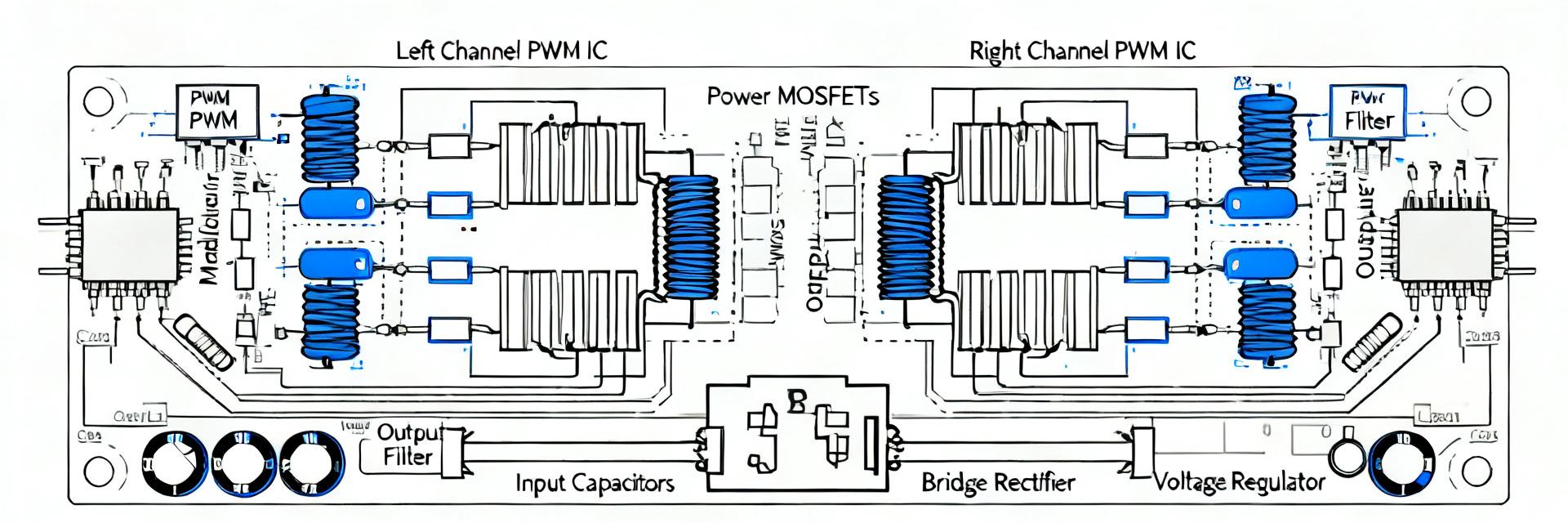
What the TAS5830DADR is
The TAS5830DADR is a stereo closed-loop Class-D amplifier with integrated audio processing and digital-audio support. Designed for soundbars and powered bookshelf speakers, it simplifies thermal design through high-efficiency switching and integrated protection features.
- Nominal Power: Up to ~65 W per channel.
- Supply Range: 12 V to 24 V single rail.
- Efficiency: Peak >90% at mid-to-high output.
- Processing: Supports sample rates up to 192 kHz with internal DSP.
- Package: Thermally enhanced HTSSOP/QFN variant.
Electrical Specs & Absolute Limits
| Parameter | Typical / Example Value |
|---|---|
| VDD Operating Range | 12 V – 24 V (18 V recommended for 4 Ω) |
| Quiescent Current (Iq) | ~50–150 mA (processing dependent) |
| Peak Output Power | ~65 W into 4 Ω per channel |
| Thermal Resistance (θJA) | Target ≤20–30 °C/W with vias |
Measured Performance & Bench Metrics
Testing under 48 kHz/24-bit digital input reveals highly linear response across the audible spectrum. Efficiency typically peaks when the output is between 30% and 60% of max rated power.
| Power Level (Per Ch) | THD+N (Typical) |
|---|---|
| 1 W (4 Ω) | <0.01% |
| 10 W (4 Ω) | ~0.02% – 0.05% |
| 60 W (4 Ω) | 0.1% – 0.5% (Thermal limited) |
Integration & PCB Design Guidelines
Power and Grounding
Place 0.1 µF and 10 µF low-ESR MLCCs immediately adjacent to VDD pins. Use star-routing for speaker outputs to prevent switching noise from contaminating the sensitive digital front-end. Ensure at least 8–12 thermal vias connect the exposed pad to a large internal ground plane.
EMI Mitigation
- Use ferrite beads on all supply lines near the IC.
- Keep high-current output loops as short as possible.
- Implement an LC filter if long speaker cables are required for radiated emissions compliance.
Frequently Asked Questions
How does a Class-D amplifier differ from linear amplifiers in efficiency?
Class-D amplifiers use high-frequency switching (PWM) to modulate the output, yielding efficiency often >90%. Unlike linear amplifiers that dissipate excess voltage as heat, Class-D stages are either fully ON or fully OFF, significantly reducing thermal requirements for the same power output.
What test conditions should be used for repeatable THD+N measurements?
Standardized benchmarks use a fixed supply (e.g., 18V), 4 Ω resistive load, a 1 kHz sine tone, and A-weighted noise filtering. Sweeping power from 1W to clipping provides a complete profile of the device's linearity and headroom.
Which PCB practices most quickly reduce audible noise in small speaker designs?
Minimizing high-current loop areas, utilizing a dedicated ground plane, and placing high-frequency bypass capacitors (MLCC) as close to the silicon as possible are the most effective ways to reduce switching artifacts and EMI.
What are the primary protection mechanisms in the TAS5830DADR?
The device includes real-time overcurrent detection, thermal shutdown with hysteresis, and short-circuit protection. These features prevent catastrophic failure during speaker faults or restricted airflow conditions.
Summary
The TAS5830DADR offers a robust, high-density solution for modern audio. By focusing on low-ESR decoupling and aggressive thermal via placement, engineers can maximize the 65W/channel potential while maintaining <0.05% THD+N at nominal listening levels.